


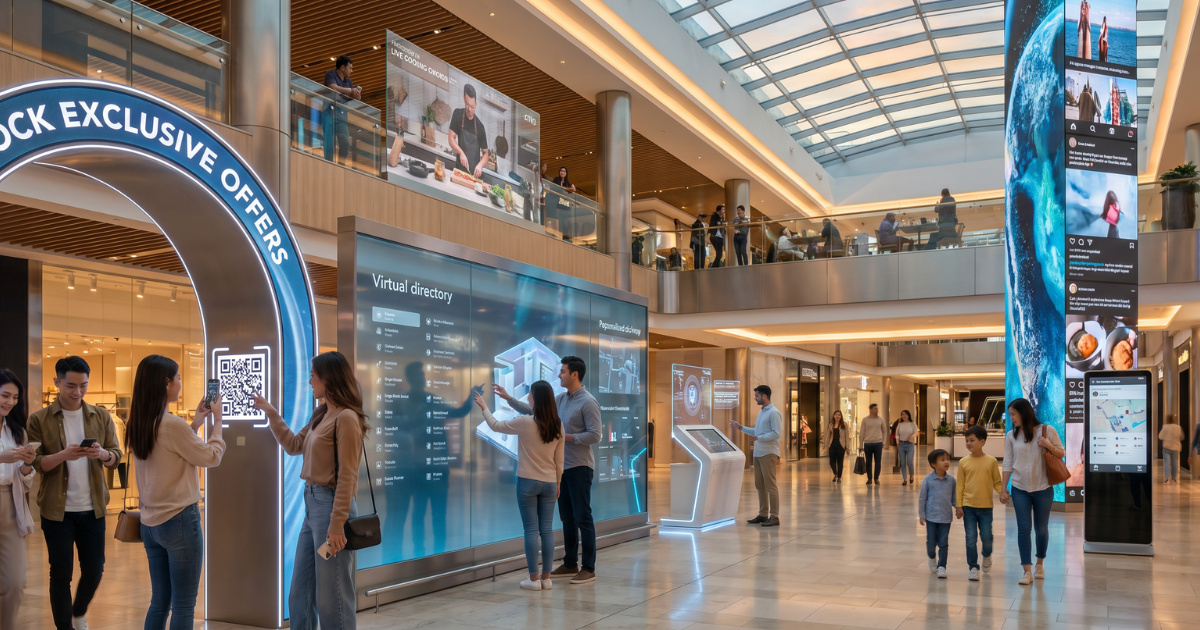
The word sounds like it was invented at a conference. It wasn't.
Phygital: physical plus digital. The deliberate integration of digital tools into physical retail environments to create a continuous experience across both. It's not about having a website and a store. It's about building a loop where the two reinforce each other in real time, so the shopper's digital journey and their physical one feel like the same journey.
Shopping centres are uniquely positioned to do this well. Most of them are barely getting started.
Why the Line Between Physical and Digital Has Blurred
Physical retail isn't in retreat. Forrester data puts physical stores at roughly 80% of global retail sales in 2025. In North America, 83.8% of Q4 2024 retail sales happened in a physical location. The store isn't going anywhere. But the way shoppers arrive at it has changed entirely.
Over 80% of consumers now visit a website or app before walking into a physical store. Almost 70% of retail sales are digitally influenced, even when the final transaction happens in person (CBRE). The shopper standing in front of a tenant's storefront has already done research on their phone. They've seen the product online. They've read the reviews. They've checked the hours. They already have context.
The gap between what a mall does digitally and what shoppers expect digitally is exactly where phygital strategy lives.
The Business Case Is Bidirectional
ICSC data makes the physical-digital relationship explicit in both directions. Opening a physical store boosts that retailer's digital sales by roughly 7%. Closing one suppresses digital sales by 11.5%. The physical and digital aren't competing. They're feeding each other.
That dynamic plays out at the property level too. When a mall has a strong digital presence, an active content ecosystem, and digital tools embedded in the in-property experience, its physical traffic benefits. The connection is measurable and it's real.
Here's What Phygital Actually Looks Like in a Shopping Centre
QR codes are the most accessible entry point, and the adoption numbers are significant. 59% of consumers now scan QR codes daily (Uniqode, State of QR Codes 2025). 94% of marketers increased their QR code usage in the past year (Bitly, via Market.us). 79% of shoppers say they're more likely to buy a product that has a scannable QR code (GS1 US Consumer Survey, 2024).
At the property level, that translates directly. QR codes on signage, displays, and event activations become data capture points, loyalty entry mechanics, and tenant traffic drivers simultaneously. The gamification mechanic we wrote about in [link to Blog 1] is built precisely on this: a shopper scans a QR code, plays a quick game, wins a prize redeemable at a specific tenant, and the property captures a first-party opt-in in the process. Opt-in rates for those experiences run around 25%, versus 2 to 4% for a standard form fill.
Beyond QR, the phygital toolkit for a property includes:
Digital guest services. 24/7 chat and voice AI that handles shopper inquiries, tenant questions, and directory navigation. Available before the shopper walks in the door, active while they're on property. It meets them where they are instead of making them hunt for an information kiosk.
Digital wayfinding and interactive directories. A static directory board tells people where stores are. A digital one that captures query data tells you what shoppers are actually looking for, which tenants they can't find, and what you might be missing.
Connected in-property screens. Screens that update in real time, tied to tenant promotions, events, or time-sensitive offers, and eventually targeted by location within the property.
AR-enabled experiences. Still early-stage for most properties, but directionally important. Sephora deployed AR try-on mirrors across 85% of its French stores in 2022 and reported a 23% increase in conversion rates (Into The Minds). IKEA's AR placement app reduced bulky product returns by 30% in 2024 (Into The Minds). These are tenant-level examples today. The technology is moving into the property environment.
The Part Most Properties Miss
Phygital tools aren't just experience features. They're data infrastructure.
Every QR scan, every chatbot interaction, every activation opt-in is a data point. What did the shopper ask? When did they arrive? Which part of the property did they engage with? What did they want that they couldn't find? That data, aggregated across thousands of interactions, gives a property team more precise insight into shopper behaviour than any survey or focus group.
Retail executives responding to Gartner's 2024 survey expected their AI and business intelligence budgets to increase by 34% and 31% respectively in 2025. The direction is clear: physical retail environments are becoming data collection infrastructure, and the properties building that capability now will have a structural advantage that compounds over time.
Where the Opportunity Is
The global phygital solutions market was $25 billion in 2023 and is projected to reach $52.5 billion by 2030. The investment is happening. But most of it is happening at the retail brand level, not the property level. Malls are the physical infrastructure for this shift. The ones that treat their building as a phygital environment, and invest in the digital tools to make that real, will be significantly better positioned than the ones that don't.
The question isn't whether shoppers want this. They already expect it. The question is whether your property is delivering it.
Interested in how DRH builds phygital infrastructure for retail properties? BOOKA MEETING
