


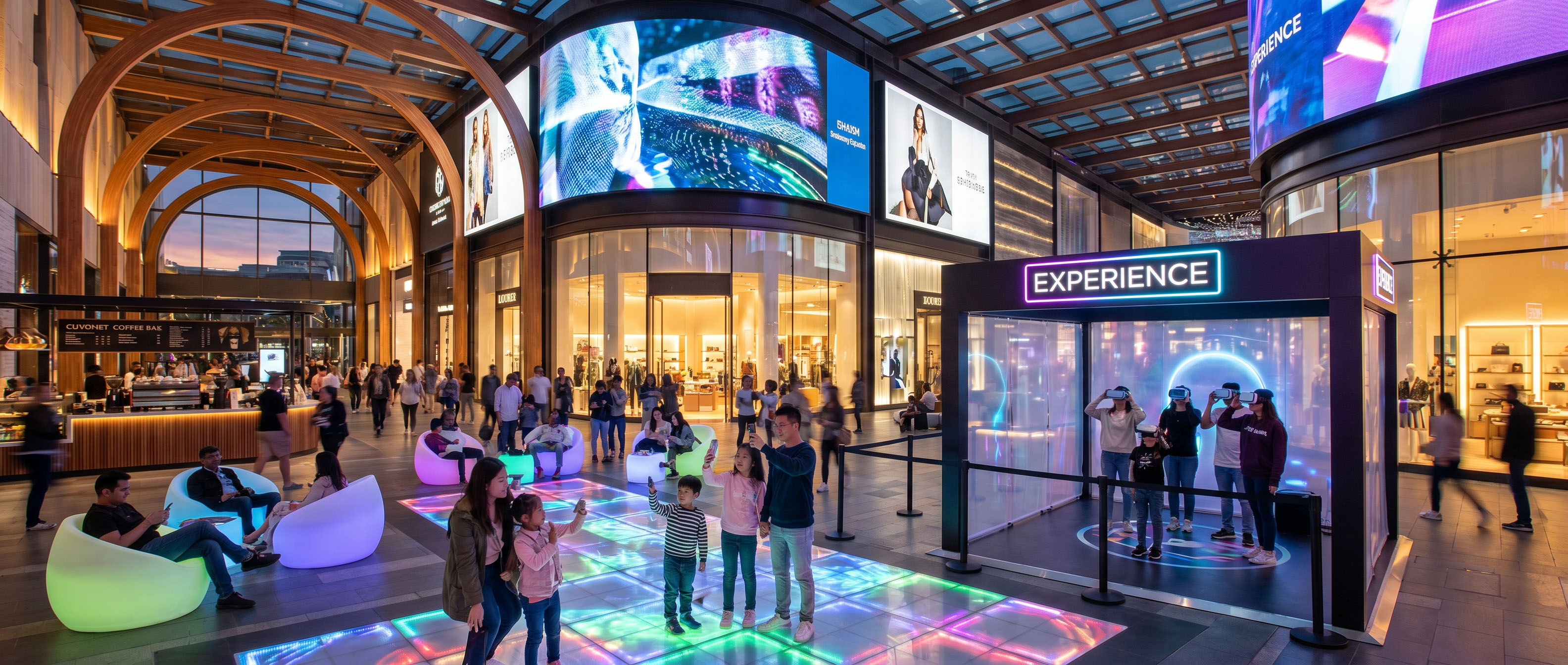
Shopping used to be about product. You went to a store, you bought something, you left.
That transaction model worked for decades. Then e-commerce made it obsolete. If the goal is simply to acquire a product, a shopper can do that faster, cheaper, and more conveniently without ever leaving home.
So what's the mall selling now? Increasingly, the answer is the experience itself. And there's a word for that: retailtainment.
What Retailtainment Actually Means
The term was coined by American sociologist George Ritzer to describe the use of sound, ambiance, emotion, and activity to get customers interested in merchandise and in the mood to buy. That definition is 30 years old. It's more relevant today than when it was written.
In practice, retailtainment is any strategy that turns a retail destination into a place people want to be, not just a place they go to buy things. Live events. Interactive technology. Immersive branded environments. Gamified activations. Pop-up experiences. Food and entertainment concepts that give people a reason to stay.
The goal isn't entertainment for its own sake. It's using experience to drive behaviour: longer visits, more tenant traffic, higher spend, and a reason to come back. The distinction matters.
Why It Matters Right Now
The experiential retail market was valued at $132 billion in 2025 and is projected to reach $543 billion by 2035 (Metatech Insights, via ICSC, August 2025). That's not a niche trend. That's the direction retail is heading.
The business case is specific. PREIT, a U.S.-based REIT managing 17 malls, found that properties with retailtainment concepts are seeing a 25% uptick in visits and a 22% jump in dwell times. Retailtainment now accounts for 17% of their tenant mix, and they're adding more. AIScreen data cited by ICSC puts the lift from these concepts at 30% increases in both store visits and sales.
The dwell time number matters most. A traditional shopping trip runs 30 to 60 minutes. Properties with strong experiential anchors are generating 2 to 4 hour visits. More time in the building means more exposure to tenants, more unplanned purchases, and more data on how shoppers actually move through the property.
Here's What That Looks Like in Practice
Netflix House at King of Prussia Mall in Pennsylvania opened in December 2024 as 100,000 square feet of immersive experience built around Stranger Things, Knives Out, and other IP, with AR, mini-golf, and themed zones. It's simultaneously a content marketing engine for Netflix and a traffic anchor for the property. Both sides win.
Dick's House of Sport at Cherry Hill Mall in New Jersey combines sports apparel with a basketball court, golf simulator, and rock climbing wall. Bauer Hockey added an in-store rink for skate fittings and ended up with 90-minute average dwell times. Nike's renovated Paris flagship on the Champs-Elysees generated a 45% increase in average visit time after its 2024 redesign (Into The Minds, September 2025).
These are large-format examples. But the mechanic scales. Seasonal pop-up activations, brand collaboration events, digital gamification tied to in-property QR codes, interactive tenant installations. The format changes. The principle is the same.
The Social Dividend
There's a compounding benefit most properties undercount. Retailtainment experiences generate 3.5x more social media shares than traditional purchases (Into The Minds, 2024), with that organic exposure estimated at roughly 15% of equivalent traditional media spend. When 98% of consumers create social or digital content at a live experiential event (Advertising Week), every activation your property runs is also a content production engine.
That matters for AI discoverability too. The more content about your property that exists across the web, the more likely you are to show up when someone asks an AI where to spend their Saturday. We covered that mechanic in detail in How Does Your Mall Get Found in an AI Search World?
The Canadian Context
The properties performing best in Canada right now are leaning into this. Yorkdale Shopping Centre produced $2,368 per square foot in 2025. CF Toronto Eaton Centre hit $1,642 per square foot, up from $1,457 in 2023 (Retail Insider, April 2026, citing ICSC data). Both are investing heavily in tenant mix and in-property experience. The results aren't a coincidence.
The collapse of Hudson's Bay in 2025 left vacant anchor space across the country. For some properties, that's a problem. For forward-thinking operators, it's an opportunity to bring in experience-driven concepts that do what a department store never could: give people a compelling reason to stay.
The Question Is No Longer Whether
Retailtainment isn't a future concept. It's a present-tense competitive advantage. The properties that have it are seeing the foot traffic numbers and dwell time data to prove it. The ones that haven't made the shift are competing purely on tenant mix and convenience, which puts them at a disadvantage against online retail and against higher-experience competitors down the road.
The real question is what version of retailtainment makes sense for your property, your market, and your tenant base. That's a strategy question. And it's worth answering now.
Interested in what an experiential strategy could look like at your property?
