


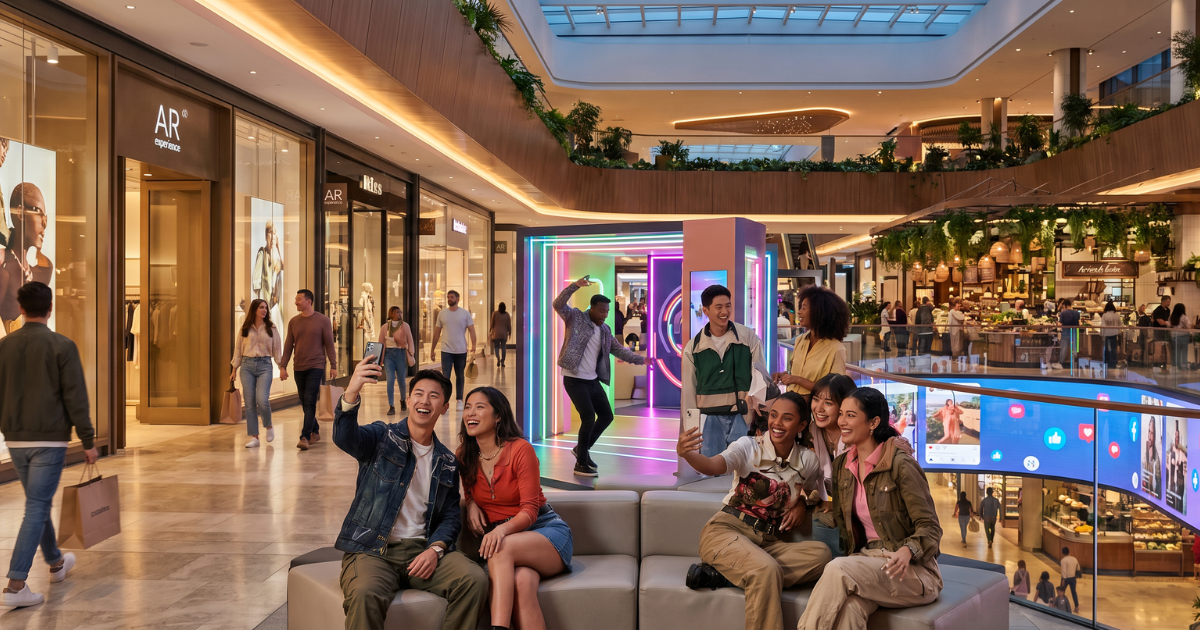
Something shifted in the last two years, and the data is catching up to what anyone spending time in a busy shopping centre already knows.
Malls are back.
Not every market. Not every property. But the trajectory is real. Indoor mall foot traffic was up 9.7% year over year in March 2024 (Placer.ai). Canadian retail foot traffic was up 5.6% in early June 2025 (Retail Council of Canada, citing Placer.ai). H1 2025 showed a 1.8% increase in visits and a 3.3% increase in visit duration compared to H1 2024 (Capital One Shopping Research, citing Placer Labs).
The generation driving that recovery is the one the industry spent a decade writing off.
60% of Gen Z and 53% of Millennials shopped at a mall in the past three months, compared to 48% of Gen X and 43% of Boomers (CBRE, 2024). The mall is the number one preferred in-person shopping destination for Gen Z at 59%, ahead of every other retail format. 62% of shoppers aged 18 to 24 made their general merchandise purchases in physical stores last year, versus 52% for shoppers over 25 (Circana, via Wall Street Journal).
The question isn't whether malls are relevant to younger consumers. They clearly are. The question is whether the marketing has caught up.
The Third Place Shift
Sociologist Ray Oldenburg coined the term "third place" in 1989 to describe informal social spaces beyond home and work. Cafes. Community centres. Barbershops. Places where people gather without agenda.
For a generation that spent its most formative years in a pandemic, the mall is reclaiming that role in a way most operators didn't see coming. More than 60% of Gen Z visits malls to socialize. 42% describe it as a social activity first, a shopping trip second (Advertising Week, citing Westfield research). Their desire for third places, for physical spaces where they can be around people, surpasses any other generation (Citizen Relations, June 2025).
Starbucks recently announced it's returning to a third-place strategy, retreating from its purely transactional digital model to rebuild physical community spaces. When one of the most recognized consumer brands in the world says physical presence is back at the centre of their experience strategy, it's worth paying attention.
The mall isn't just a place to buy things anymore. It's a place to be. That's a fundamentally different marketing challenge.
What the Best Canadian Properties Are Proving
The performance polarization in Canadian retail is sharp and getting sharper. CF Toronto Eaton Centre hit $1,642 per square foot in 2025, up from $1,457 in 2023. Yorkdale Shopping Centre is at $2,368 per square foot (Retail Insider, April 2026, citing ICSC data). Those numbers are world-class.
But they're not the whole picture. Mid-tier properties are struggling. Hudson's Bay's collapse in 2025, after 355 years in Canadian retail, accelerated a divide that was already forming. The properties winning are investing in experience, tenant mix, and community connection. The ones that aren't are competing on convenience in a market where convenience is Amazon's home game.
The difference isn't just real estate and tenant selection. It's marketing. How a property positions itself, what story it tells, and whether that story reaches the right people in the right places.
Where the Marketing Hasn't Kept Pace
Here's what I keep seeing. A property is genuinely delivering a strong experience. The food hall is interesting. The tenant mix is good. There are events worth attending. But the marketing looks like 2015.
Static social posts. Seasonal sale graphics. A Facebook event for the holiday activation that 200 people see.
Meanwhile, 64% of Gen Z prefer to shop in-store when discovering new products (Advertising Week). But they're discovering those products through content, not through a mall's Facebook page. They're finding them through creators, through short-form video, through AI search, through a friend posting about a restaurant inside the building.
The property is the destination. The marketing needs to make it discoverable where the audience is actually looking. That's a content infrastructure problem, not a budget problem.
The Gap Is an Opportunity
The reality is that most malls are undermarketed relative to the experience they're actually delivering. That gap is a real opportunity for the properties willing to close it.
It means building a content ecosystem that works independently of your advertising spend. It means briefing your tenants to tag your location and share your events. It means working with local creators whose audiences match your shopper profile. It means making sure your property shows up when someone asks an AI where to take their family this weekend. We covered what that looks like in detail in [link to Blog 3: How Does Your Mall Get Found in an AI Search World?].
And it means marketing the social experience, not just the retail one. If 42% of your shoppers are coming to socialize and spend time, your content should reflect that. The visit duration data, up 3.3% in H1 2025, suggests that when people arrive, they're staying. Your job is to get them through the door in the first place.
The malls are doing their part. The marketing still has room to catch up.
Want to talk about how DRH helps retail properties close that gap?
