


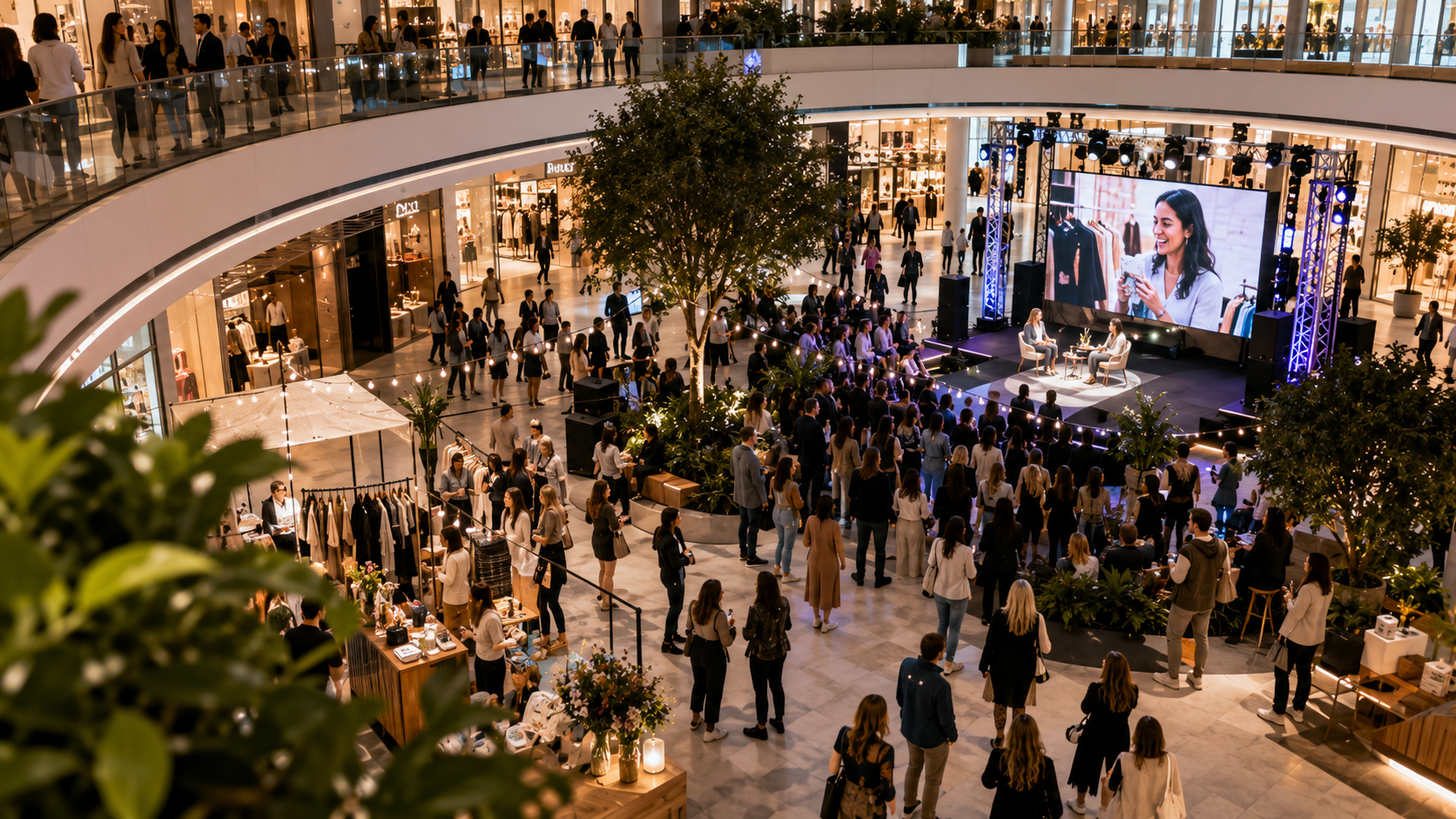
The events are good. The activations look great on social. Shoppers showed up.
Now ownership is asking what it drove. And most marketing teams don't have a clean answer.
That gap, between executing a strong event program and being able to prove what it produced, is one of the most common problems in retail property marketing today. It's not a question of whether events work. The data on that is clear. It's a question of whether your property has the infrastructure to connect the event to a number ownership recognizes.
What the Data Actually Says
A 1% increase in dwell time produces a 1.3% increase in sales (Pathintelligence, via Retail Sensing 2025). That's not a hypothesis. It's a tracked correlation across thousands of in-store visits.
Dwell time correlates with revenue per visit at a coefficient of 0.71. Raw entry count, the number most properties report, correlates at only 0.43 (Ariadne, 2024-2025). In plain terms, how long people stay predicts what a centre earns far better than how many people walk in. If you're reporting foot traffic to ownership without dwell time data, you're handing them the less useful number.
Stores offering immersive experiences see 40% longer visits and 30% higher sales than traditional retail setups (Mapsted, August 2025). Purchase frequency increases 16.7%, and purchase quantity increases 28.6% among customers who engage with experiential retail (Rockbot, 2025). And experiential spend globally hit $128.35 billion in 2024, surpassing the pre-pandemic peak of $121.87 billion in 2019 for the first time (ATN Event Staffing, citing EventTrack 2025).
The activity is growing because it works. The measurement gap is the part that's still catching up.
Why Most Properties Can't Prove It
Nielsen's 2025 Annual Marketing Report found that 85% of marketers express confidence in their ability to measure ROI, but only 32% actually do it correctly or comprehensively. That's a 68% measurement gap in practice.
At a retail property, the problem has two layers.
First, most event measurement stops at attendance. Head counts, social impressions, a post-event survey if the team had bandwidth. None of those answers the ownership question, which is always a version of: what did we sell more of because of this, and was it worth the spend?
Second, the multi-tenant structure makes attribution genuinely hard. A single-brand retail event is contained. A mall event drives traffic that disperses across 100 or more tenants, and those tenants rarely share POS data back to the property manager. Without a closed-loop system, the revenue impact of even a strong event is effectively invisible.
The Measurement Framework That Works
It's a pre- and post-design. Simple in concept, but it requires the right tools in place before the event runs.
Start with a clean baseline. Pull people counter data for the same day and time across three to four comparable weeks, accounting for weather and any competing events. That's your control number.
During the event, measure zone-specific traffic. Not just entries, but where people went and how long they stayed. Overhead people counters or mobile location data (Placer.ai, Ariadne) can provide this at the property level. The goal is to isolate the event's footprint from baseline traffic patterns.
After the event, calculate incremental lift. Incremental visitors multiplied by your property's average basket size and category conversion rate gives you a defensible revenue impact number. Pair that with any available tenant sales data from the event window, and you have an ownership-ready calculation.
The full calculation: event cost divided by incremental revenue generated equals your event ROI. That number belongs in every post-event report.
The Piece Most Properties Skip: Data Capture
Events are the highest-engagement moments at a retail property. They are also the best opportunity to build the first-party data foundation that makes every future marketing effort more effective.
When shoppers attend an event, they're already in a high-trust, high-engagement state. A QR-enabled registration, a contest entry tied to a loyalty opt-in, a gamified activation with a digital component: any of these creates a consent-based data relationship that doesn't expire when the event ends. In-store and in-person sign-ups to loyalty programs nearly doubled year over year, from 4% to 8% of total sign-ups (EY Loyalty Market Study, December 2024). Events are driving that shift.
First-party data collected through events converts at dramatically higher rates than third-party data. Members redeeming personalized rewards spend 4.5 times more annually than those receiving generic offers (Yabble, 2024). 83% of Canadian consumers value personalized offers, but only 8% actually receive tailored recommendations in a relevant, timely way (iSeatz, Canada's Loyalty Evolution 2025). That gap is where well-run event programs with proper data capture create a durable competitive advantage.
What Ownership Actually Wants to Hear
The conversation shifts when you walk in with: incremental visits, dwell time lift, estimated revenue impact by tenant category, cost-per-incremental-visit, and new loyalty opt-ins from the event period.
That's not a marketing report. That's a capital allocation argument. And it's the only way to get more budget for the next event.
The events are already working. Build the infrastructure to prove it and the program funds itself.
Ready to build a measurement framework for your property's event program?
